

IGCSE Chemistry tutor online (0620)
Taught for Cambridge (CAIE) and Pearson Edexcel.
At a glance
Our IGCSE Chemistry tutors teach Cambridge 0620 (Core and Extended) and Pearson Edexcel International GCSE Chemistry 4CH1, from bonding and moles to electrolysis, rates, the Periodic Table and organic chemistry, with practical-paper preparation. Classes are live online, 1:1 or in small groups, timed for the Gulf, the UK and Pakistan.
IGCSE Chemistry key facts
| Cambridge (CAIE) | Cambridge IGCSE Chemistry (0620), 6 papers/components (official syllabus) |
|---|---|
| Pearson Edexcel | Pearson Edexcel International GCSE in Chemistry (4CH1), 2 papers/components (official syllabus) |
| Cambridge May/June series | Exams run from late April to June; results are released in mid-August. |
| Cambridge October/November series | Exams run in October and November; results are released in mid-January. |
| Pearson Edexcel International GCSE series | Exams are offered in May/June for all subjects and in November for a smaller set of subjects. |
| Topics covered | 12 syllabus topics, with past-paper practice |
| Lesson format | Live online, 1:1 (60 min) or small group (75 min); first class free |
Facts last verified:
IGCSE Chemistry is essential for students who may later study medicine, pharmacy, chemical engineering or any A Level or IB science, and international schools in the Gulf usually offer it as a separate science. Cambridge 0620 has twelve topics, from states of matter to chemical analysis, with Supplement material for Extended candidates. Edexcel 4CH1 groups content into principles of chemistry, inorganic, physical and organic chemistry, marking harder statements in bold for its second paper.
Cambridge Extended candidates take Paper 2 (45-minute multiple choice, 40 marks, 30%), Paper 4 (theory, 1 hour 15 minutes, 80 marks, 50%) and either Paper 5, a practical test, or Paper 6, Alternative to Practical, for the remaining 20%. Core candidates take Papers 1 and 3 in place of 2 and 4. Edexcel 4CH1 has two untiered papers: Paper 1 lasts 2 hours (110 marks, 61.1%) and Paper 2 lasts 1 hour 15 minutes (70 marks, 38.9%).
The most common sticking points are calculations involving moles, concentration and gas volumes; writing balanced ionic and half-equations; explaining bonding and structure in terms of particles and forces; and organic reaction pathways. Chemical tests must be learned exactly, as vague observations earn nothing. Strong IGCSE Chemistry makes A Level and IB Chemistry far smoother, because stoichiometry, energetics and organic chemistry are revisited at speed in the first term.
How is IGCSE Chemistry (0620) examined?
Cambridge IGCSE Chemistry (0620)
Official syllabus from Cambridge (CAIE)| Paper | Duration | Marks | Weighting |
|---|---|---|---|
| Paper 1: Multiple Choice (Core)Core candidates | 45 minutes | 40 | 30% |
| Paper 2: Multiple Choice (Extended)Extended candidates | 45 minutes | 40 | 30% |
| Paper 3: Theory (Core)Core candidates | 1 hour 15 minutes | 80 | 50% |
| Paper 4: Theory (Extended)Extended candidates | 1 hour 15 minutes | 80 | 50% |
| Paper 5: Practical TestAll candidates take Paper 5 or Paper 6 | 1 hour 15 minutes | 40 | 20% |
| Paper 6: Alternative to PracticalAll candidates take Paper 5 or Paper 6 | 1 hour | 40 | 20% |
Syllabus for examination in 2026, 2027 and 2028. Core: grades C to G. Extended: grades A* to G. Examined in the June and November series (and March in India). A 9–1 graded version is 0971.
Pearson Edexcel International GCSE in Chemistry (4CH1)
Official syllabus from Pearson Edexcel| Paper | Duration | Marks | Weighting |
|---|---|---|---|
| Paper 1 (4CH1/1C)Assesses core content (not in bold); also forms part of the Science (Double Award) | 2 hours | 110 | 61.1% |
| Paper 2 (4CH1/2C)Assesses all content, including bold 'C' statements | 1 hour 15 minutes | 70 | 38.9% |
Untiered. Calculators allowed. Examined in the June and November series.
Cambridge May/June series
Exams run from late April to June; results are released in mid-August.
Cambridge October/November series
Exams run in October and November; results are released in mid-January.
Pearson Edexcel International GCSE series
Exams are offered in May/June for all subjects and in November for a smaller set of subjects.
Exam facts last verified:
Plan your revision with our exam dates guide, the official IGCSE grade thresholds and where to find official past papers.
What topics are in IGCSE Chemistry?
- 1
States of matter
Explaining diffusion without linking speed to relative molecular mass or temperature.
- 2
Atoms, elements and compounds
Explaining melting points without naming the forces or bonds that must be overcome.
- 3
Stoichiometry
Forgetting the mole ratio from the equation and losing track of significant figures in percentage yield.
- 4
Electrochemistry
Ignoring concentration when predicting products at the anode in aqueous electrolysis.
- 5
Chemical energetics
Sign errors in bond-energy calculations and labelling activation energy from the wrong level.
- 6
Chemical reactions
Describing equilibrium shifts without referring to the forward or reverse reaction.
- 7
Acids, bases and salts
Naming the wrong salt and forgetting filtration or crystallisation steps in preparation methods.
- 8
The Periodic Table
Predicting halogen displacement reactions incorrectly.
- 9
Metals
Explaining alloy hardness without referring to distorted layers of atoms.
- 10
Chemistry of the environment
Linking the wrong pollutant to acid rain, climate change or photochemical smog.
- 11
Organic chemistry
Naming isomers incorrectly and drawing polymer repeat units without extension bonds.
- 12
Experimental techniques and chemical analysis
Choosing the wrong separation technique and calculating Rf values from the wrong distances.
Not sure which fits? Chat on WhatsApp
How do our online Chemistry classes work?
Diagnostic
A short check of what your child already knows against the syllabus.
Topic teaching
Clear explanations on a shared whiteboard, one topic at a time.
Past-paper practice
Exam questions from your board, timed and marked to the mark scheme.
Feedback
What went well, what to fix and what to practise before next class.
Who teaches IGCSE Chemistry?
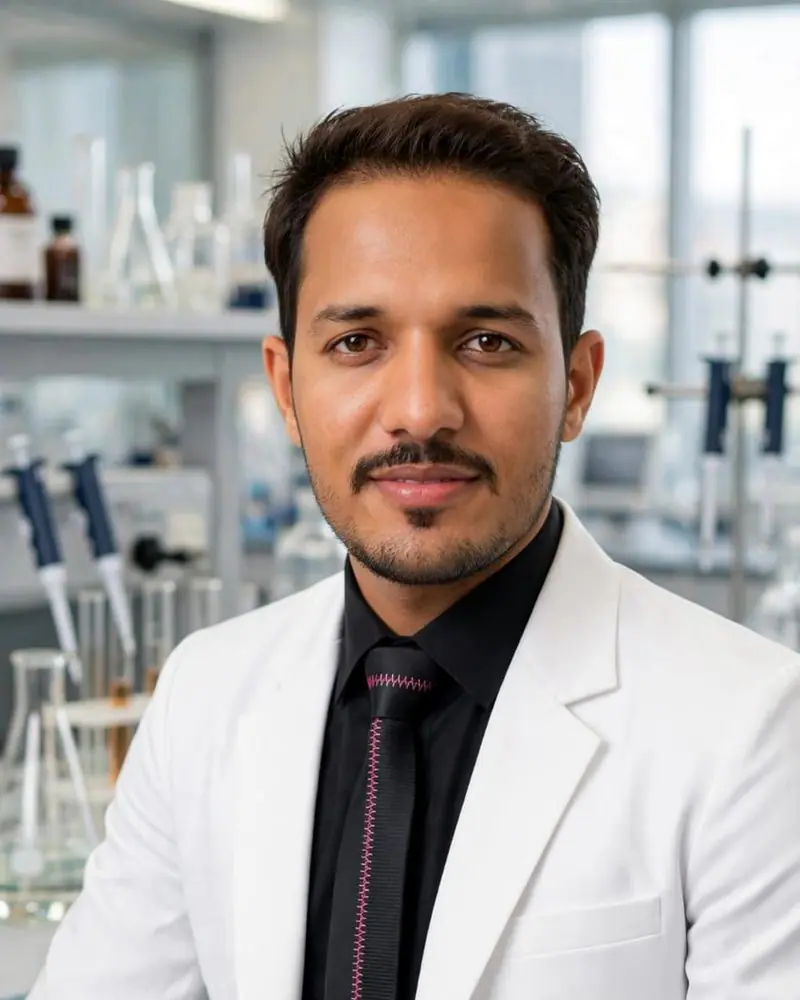 11 years
- Chemistry
- Biology
How do you get top marks in IGCSE Chemistry?
Check whether you are entered for Core or Extended (Cambridge) and revise Supplement content only if you are Extended.
Write the balanced equation before any mole calculation and show each step, including the mole ratio.
Learn test results word for word, for example 'turns limewater milky' or 'relights a glowing splint'.
In bonding questions, name the particles and the forces between them; 'strong bonds' alone rarely scores.
For Edexcel, revise the bold 'C' statements thoroughly, because they appear only on Paper 2.
In practical questions, state apparatus precisely, such as 'measuring cylinder' or 'burette', and give units in tables.
How much does IGCSE Chemistry tutoring cost?
Prices shown in US dollars
- Recommended
One-to-one
Fully personalised to your child
USD 28 / class
- 60-minute live classes at times you choose
- A plan built from a diagnostic of your child's gaps
- Past-paper practice marked against the mark scheme
- Progress notes for parents
Small group
Up to 6 students, 8 live classes a month
USD 8 / class
- 75-minute live classes, 8 per month
- Taught to your exam board and syllabus code
- Weekly past-paper questions with feedback
- Class recordings and notes
Intensive exam prep
12 one-to-one classes a month before exams
USD 25 / class
- Three 60-minute classes a week
- Timed past papers and full mock exams
- Topic-by-topic weak-spot drills
- Pack discount of 10% applied
Prices are per class unless shown per month: one-to-one classes are 60 minutes and group classes 75 minutes. Your trial class is free and doesn't turn into a paid plan by itself. Pricing FAQ
IGCSE Chemistry FAQs
What is the difference between Core and Extended IGCSE Chemistry?
Core IGCSE Chemistry covers the Core syllabus content and leads to grades C to G, while Extended includes additional Supplement content and allows grades A* to G. Core candidates sit Papers 1 and 3; Extended candidates sit Papers 2 and 4. Both tiers take a practical paper, either Paper 5 or Paper 6.
How many papers are there in IGCSE Chemistry 0620?
Every Cambridge IGCSE Chemistry 0620 candidate sits three papers: a 45-minute multiple-choice paper worth 30%, a 1 hour 15 minute theory paper worth 50%, and a practical paper worth 20%. Which numbered papers you take depends on your tier, and the practical can be the lab-based Paper 5 or the written Paper 6.
Is IGCSE Chemistry hard?
IGCSE Chemistry is moderately hard, because it mixes calculations, equation writing and precise explanation. Students who keep up with mole calculations and learn test results carefully usually do well. Organic chemistry and electrolysis often feel difficult at first, but steady practice with past-paper questions makes them predictable.
What is Paper 6 in IGCSE Chemistry?
Paper 6 in Cambridge IGCSE Chemistry 0620 is the Alternative to Practical, a 1-hour written paper worth 40 marks and 20% of the grade. It assesses practical knowledge on paper, such as apparatus, measurements, observations, chemical tests, data handling and planning. It is taken instead of Paper 5, the laboratory-based practical test.
Should I take Cambridge or Edexcel IGCSE Chemistry?
Students usually follow whichever board their school offers, since Cambridge 0620 and Edexcel 4CH1 cover similar chemistry. Cambridge is tiered and includes multiple-choice and practical papers, graded A* to G. Edexcel has two untiered written papers graded 9 to 1. Both are accepted for progression to A Level and IB.
How can I get an A* or a 9 in IGCSE Chemistry?
Achieving an A* or 9 in IGCSE Chemistry requires full content coverage, accurate calculations and exact wording for definitions and tests. Practise past papers under timed conditions and mark them strictly against official mark schemes. Our tutors target the topics that cost each student marks, but no tutor can guarantee a grade.
Still deciding? Ask us on WhatsApp
Related subjects and guides

IGCSE in the UAE & Saudi Arabia: A Parent's Guide to Boards, Exams and Tutoring
IGCSE in the UAE and Saudi Arabia explained: Cambridge vs Edexcel grading and tiers, exam series, British Council private entry and the 2026 disruption.
9 min readUpdated
IGCSE vs O Level: What's the Difference?
IGCSE and O Level are equivalent Cambridge qualifications. They differ in availability, grading (A*–G vs A*–E), subject range and IGCSE tiers.
10 min readUpdated


Try a free IGCSE Chemistry class
Tell us the curriculum and subject. We'll match a specialist tutor in your timezone.